
October 23, 2026
Coccyx pain: a holistic perspective on your tailbone
Understanding coccyx pain through a musculoskeletal perspective and Lifestyle Prescriptions® Health Coaching, with practical support for comfortable sitting.
The coccyx is small, but pain in this area can have a considerable effect on everyday life. Sitting at a desk, driving, enjoying a meal or moving from sitting to standing can become uncomfortable. Some people also experience pain during bowel movements or sexual intercourse.[1,8]
Pain in and around the coccyx is called coccydynia, also known as coccygodynia. Understanding this area helps us recognise a possible source of pain at the bottom of the spine and make more informed choices about sitting and seeking help.
This article brings together anatomical research, practitioner teaching and my understanding developed through exploration and clinical experience. It offers different perspectives on coccyx pain, including Lifestyle Prescriptions® Health Coaching, to encourage understanding and personal enquiry. It is not intended to diagnose the cause of an individual’s symptoms or replace appropriate medical assessment or treatment.
What is the coccyx?
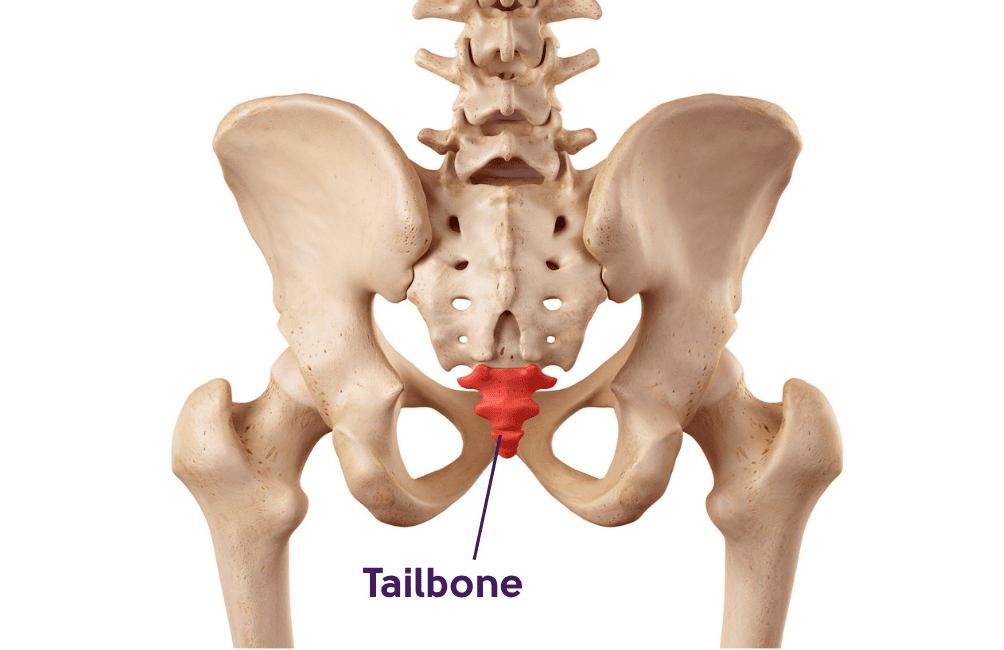
The coccyx, or tailbone, lies below the sacrum at the very bottom of the spine. It usually comprises three to five small vertebral segments. These vary considerably in their shape, curvature and degree of fusion. There is no single shape that every healthy coccyx must have.[2]
It provides attachment for muscles and connective tissues associated with the pelvic floor. These include the coccygeus and connections with the levator ani. The coccygeus also attaches to the lower sacrum and the ischial spine of the pelvis. These relationships help explain why the coccyx belongs in our understanding of pelvic function.[3]
The pelvic floor supports the pelvic organs and must both contract and relax appropriately. Its function involves coordination, rather than strength alone.[3,7]
Does the tailbone normally move?
Often, yes. Movement can occur at the joint between the sacrum and coccyx and between coccygeal segments. However, some joints are naturally fused. A CT study of 112 adults found sacrococcygeal fusion in 57%, illustrating why lack of movement at this one joint does not, by itself, establish a painful disorder.[2]
Both excessive movement and reduced movement can be relevant in people with pain. In a study comparing 91 people with coccydynia and 47 healthy controls, researchers used standing and sitting X-rays to assess movement under load. They defined excessive flexion as more than 25 degrees and identified displacement or excessive movement in approximately half of the patients.[4]
Barral and Mercier (see below) describe an approximately 30-degree range of coccygeal movement in Visceral Manipulation (2005).[16] Movement figures need to be understood in the context of the assessment method: the range explored during a manual examination is not automatically equivalent to movement measured between standing and seated X-rays. Clinical interpretation also takes account of the person’s anatomy, symptoms and examination findings.[4,16]
A musculoskeletal perspective
A common clinical starting point is to ask which tissues are painful, how they respond to pressure and movement, and whether injury, joint changes or pelvic floor dysfunction may be involved. The following sections describe this approach and the treatments it can lead to. Emotional and social factors can also be considered in musculoskeletal care; the distinction here is the focus of the enquiry.
What commonly causes coccyx pain?
A fall or direct impact
Falling backwards onto the bottom can injure the tissues around the coccyx. An injury can involve bruising, ligament strain, fracture or joint displacement. Persistent pain deserves assessment rather than an assumption that the bone is simply “out of place”.[1,4]
Childbirth
The coccyx can be injured during vaginal delivery. In a specialist-clinic study of 57 women with postpartum coccydynia, difficult or assisted births were prominent. Coccygeal displacement was found in 43.9% and fracture in 5.3%.[5]
These figures describe women attending a specialist clinic with pain; they are not the risk of these injuries for everyone giving birth.
However, pain that begins when sitting after delivery should not simply be dismissed as an inevitable part of recovery.
Repeated pressure or prolonged sitting
Long periods of sitting, driving or cycling can aggravate the coccyx. Higher body weight can increase loading, while very little natural padding may also contribute to discomfort.[1]
Joint movement and local tissue irritation
Some painful coccyges are unusually mobile or displace when loaded; others are relatively rigid. Pain can also arise around the coccygeal tip or joints, rather than from one simple movement fault.[4,6]
In an MRI study of 172 people with severe chronic coccydynia, researchers found patterns consistent with joint inflammation, fluid changes and irritation of tissues around the coccygeal tip. Findings differed between mobile and rigid coccyges.[6]
Pelvic floor muscle problems
Overactive or poorly coordinated pelvic floor muscles can coexist with coccyx pain. Muscle guarding may be part of the problem even when there is no obvious fracture or displacement.[7]
Sometimes no single cause is identified. This does not make the pain less real.[1]
What about coccyx pain in men?
In my work, I hear women describe falling onto their tailbone more often than men. This made me curious about the difference. Although women are more frequently seen with persistent coccyx pain, men experience it too — following an injury, through repeated pressure when sitting, or alongside other pelvic symptoms.
I explore this further in a separate article, Coccyx pain in men.
How can coccyx pain affect the rest of daily life?
Sitting and changing position
A characteristic pattern is local tenderness and pain when sitting, sitting down or getting up. Pain can be dull and aching or intermittently sharp. Sleep and normal activities may also be affected.[1]
A person may start leaning away from the painful area or repeatedly changing position. These responses are understandable, but they do not tell us which structure is responsible. The practical aim is to find tolerable positions and movement while investigating persistent symptoms.
Pelvic floor function and bowel movements
In a study of 127 women attending pelvic floor physiotherapy for pelvic pain, 63 also had coccydynia. Those with coccyx pain more often had coccygeus spasm, pelvic floor coordination difficulties and constipation associated with difficulty evacuating the bowel.[7]
This is a clinically useful association, but it does not establish which problem came first. It also does not mean half of all women have coccyx pain: these participants were already seeking care for pelvic pain.
Pain and guarding can coexist. For this reason, repeatedly squeezing the pelvic floor is not necessarily the right starting point. Assessment may indicate relaxation and coordination work, strengthening, or a combination.[7,9]
Sexual discomfort and urinary symptoms
Coccyx pain can be aggravated by intercourse. An overactive pelvic floor may also be associated with painful sex, bladder discomfort, difficulty initiating urination or a feeling of incomplete emptying.[8,10]
These symptoms deserve appropriate assessment. They should not automatically be attributed to a restricted coccyx. Pelvic pain has many possible causes, including conditions affecting the bladder, bowel and reproductive organs.[11]
Osteopathic accounts also explore relationships between coccygeal mobility and pelvic-organ function, as discussed below. These proposed relationships deserve consideration, but the sources reviewed do not establish coccyx restriction as a general cause of interstitial cystitis, pelvic organ prolapse, prostatitis or haemorrhoids. An anatomical relationship or coexisting symptoms do not, on their own, demonstrate causation.[16–21]
Is the coccyx a cause of low back pain?
The coccyx is a recognised source of pain at the very bottom of the spine. However, coccydynia and lumbar low back pain are different clinical presentations. A painful tailbone should not be assumed to explain all pain across the lower back.
Local tenderness and pain provoked by sitting make coccyx involvement worth considering. Examination helps distinguish this from other sources of pain. For selected persistent cases, standing and seated X-rays can reveal movement-related problems that a single static image may miss. MRI can provide further information when the cause remains unclear or another condition is suspected.[4,6]
The tailbone can be an overlooked source of pain at the base of the spine, particularly when sitting is uncomfortable. It is one possible contributor to pain in this region.
What treatment can involve
Treatment should reflect the source of symptoms. Alongside pressure relief and changes to aggravating activities, a clinician may suggest physiotherapy, suitable pain relief or an injection. Surgery is reserved for selected persistent cases.[1]
Pelvic health physiotherapy may be particularly relevant where there is muscle overactivity or difficulty coordinating the pelvic floor. A retrospective study found that average pain scores among 79 people completing treatment fell from 5.08 to 1.91 after an average of nine sessions focused on pelvic floor relaxation. Because there was no randomised comparison group and some patients received additional treatments, this supports a treatment option without proving that it will work for everyone.[9]
Manual treatment is also not a universal solution. A randomised trial of 102 patients found only mild benefit from internal coccygeal manipulation.[14] Any internal assessment or treatment requires an appropriately trained clinician, a clear reason and informed consent.
Jean-Pierre Barral’s perspective: the coccyx within the pelvis
The work of osteopath Jean-Pierre Barral offers another perspective on this region. His book Visceral Manipulation, co-authored with Pierre Mercier, includes a dedicated chapter on the coccyx. His Urogenital Manipulation explores the relationships between the pelvis, spine, bladder and reproductive organs.[16,17]
In this osteopathic approach, assessment considers the movement and relationships of organs, their supporting tissues and the musculoskeletal system. The Barral Institute’s pelvic curriculum teaches practitioners to consider the integration of pelvic organs with the ligament systems of the pelvis and to explore both visceral and musculoskeletal contributions to pelvic and low-back symptoms.[18]
This provides a reason to look beyond the site of pain when assessing a person. It also requires a distinction between anatomical connections, a practitioner’s interpretation of tissue findings, and evidence that a particular restriction causes a particular symptom. Barral’s framework can inform clinical questions without every proposed relationship being regarded as established causation.
Coccyx-specific clinical observations
The Barral Institute publishes practitioner case reports that illustrate this broader assessment approach:
- Anna Cawthorne, physiotherapist: a woman with severe coccyx pain, difficulty sitting and accompanying bladder/bowel symptoms received treatment addressing several structures, including pelvic ligaments, pudendal nerves, the lumbosacral region and pelvic tissues. The report records a 60–70% improvement in symptoms after four sessions. Prolonged sitting remained uncomfortable and some pelvic symptoms persisted.[19]
- Sarah Labrecque, physiotherapist: a woman with longstanding pain after two road accidents received a combination of visceral, musculoskeletal and other manual treatments. After ten sessions she could sit for 20 minutes, walk for up to an hour and resume light housework; neck and shoulder pain had resolved. Coccyx pain could nevertheless still reach 10/10 with prolonged sitting, and she was referred back for further assessment.[20]
These are clinical observations rather than controlled experiments. They document meaningful improvements alongside unresolved symptoms. Because several interventions were used, they cannot identify which treatment produced the changes or confirm the proposed mechanisms. They also concern practitioners using Barral’s approach, rather than cases personally treated by Barral.
Research co-authored by Barral
A 2019 study by Lyne Archambault-Ezenwa, Alycia Markowski and Barral reviewed ten men with chronic pelvic pain. It explored findings across the musculoskeletal, visceral and nervous systems. Treatment included several approaches, with sacral/coccygeal mobilisation among the options. Seven men reported subjective improvement of at least 50%.[21]
The study was small and retrospective, with one treating and assessing therapist and inconsistent completion of validated questionnaires. It supports further investigation of comprehensive assessment, but cannot isolate the effects of coccyx treatment or establish coccyx restriction as a cause of prostatitis.[21]
Taken together, this work broadens the questions we can ask about persistent coccyx and pelvic pain. Limited testing leaves uncertainty; it does not by itself demonstrate that a clinical observation is wrong. The appropriate next step is to examine the observation and its possible explanations carefully.
A Lifestyle Prescriptions® Health Coaching perspective
Alongside understanding the physical structures, I offer Lifestyle Prescriptions® Health Coaching to explore what was happening in a person’s life when symptoms began, what keeps recurring, and what changes may help them move forward.
Lifestyle Prescriptions® Health Coaching uses Organ–Mind–Brain Anatomy™ as a framework for exploring proposed connections between specific symptoms, stress triggers, emotions, beliefs, relationships and daily habits. Its training includes a structured enquiry process, listening skills and practical changes that clients choose for themselves.[22]
Looking at the experience as well as the painful area
With coccyx pain, I am interested in both the experience of sitting and the wider circumstances surrounding the symptoms. What changed before the pain appeared? What does the person notice when they feel settled, under pressure, restricted or supported? Has pain itself changed how they feel about their body?
The enquiry can include self-worth, dignity, personal space, relationships and a sense of choice, where these arise from the person’s own account. For someone whose symptoms affect intimacy or using the toilet, the emotional impact of those difficulties may also deserve attention. These are possible subjects for exploration, not a universal explanation attached to the coccyx.
We can look at what happened before the symptoms, during them and at times when they eased. A meaningful connection may emerge gradually. There is no need to force an interpretation or disclose anything that feels too private.
My observation during lockdown
During lockdown, I saw an increase in the number of new clients with coccyx pain. That pattern caught my attention and reinforced my interest in exploring what was happening in their lives alongside their physical symptoms.
Lockdown could alter many things at once: time spent sitting, opportunities to move, work, relationships, privacy, social contact and a sense of freedom. My observation invites questions about these experiences.
Research involving people with a range of chronic pain conditions — not specifically coccyx pain — found greater pain intensity during full national lockdown, with depressive symptoms accounting statistically for part of that relationship. This supports attention to emotional and social circumstances, although it was not a study of coccyx pain or a test of Organ–Mind–Brain Anatomy™.[24]
Questions for personal reflection
You might gently consider:
What was happening in my life before this pain began?
Was there a situation I felt I had to “sit out” — waiting for something to change or being unable to take action?
How did I feel about that waiting: comfortable with it, frustrated, excluded, powerless — or something else?
Was I able to express what I wanted or needed?
What changed in my sitting, movement, work or home environment during that time?
When the pain eases, what is different — physically, emotionally or in my circumstances?
What small step could give me more comfort, participation or choice now?
These questions reflect themes I explore through Lifestyle Prescriptions® Health Coaching and are invitations for you to notice your own experience.
Turning awareness into something practical
Coaching can help translate what you notice into manageable actions: a clearer boundary, a conversation, more regular movement breaks, a different work arrangement, a supportive routine or a small step towards something you value. The priorities and goals belong to the client. This reflects the client-centred approach described in the Lifestyle Prescriptions® Health Coaching code of practice.[23]
Living with persistent pain can be frustrating, especially when you cannot make sense of why it began or keeps returning. Taking time to explore what was happening in your life can bring understanding and reveal something you feel ready to address.
In my Lifestyle Prescriptions® Health Coaching work, this exploration begins with listening. For someone who has felt obliged to “sit out” a difficult situation, there may be relief in acknowledging how hard that has been, expressing what they need or finding a choice they had not previously recognised. What emerges is personal — we allow time to discover what feels relevant, without forcing an explanation.
Why giving the tailbone space can help
When your tailbone is sore, the way you sit can make a considerable difference. The aim is to support your weight through your sitting bones while giving the tender area some space.
Notice what happens when you slump into a soft settee or slide forwards in a chair. Your pelvis rolls backwards into a posterior pelvic tilt, which can bring more pressure onto the coccyx. A driving position that leaves you sitting back on your tailbone may have a similar effect.
You may already recognise these positions because they increase your pain. During recovery, it is worth adjusting them rather than repeatedly waiting for discomfort to tell you to move.
Try sitting with your feet supported and your weight comfortably over your sitting bones. You do not need to force yourself upright or hold an exaggerated arch in your lower back. If a chair leaves you sinking backwards, try a different seat or a support that helps you settle without pressing on the tailbone.
A support with a rear opening can provide space around the coccyx. Position it so the tender area sits over that space, rather than against an edge.
Even a comfortable position benefits from variety. Change position regularly, stand up and move when you can, and take breaks from sitting before the pain builds. Let your own response guide the adjustments.
Sitting with the Buttafly
The Buttafly was designed for yoga and meditation and can be used for cross-legged sitting on the floor or for sitting on a chair. Some people with coccyx pain have also reported useful relief when using it for everyday sitting.
Although fairly firm, with a feel similar to a regular yoga block, a perhaps surprising number of people find it stable and comfortable on top of an office chair. The author, Loulou James, is among those who enjoy using it this way. These are personal experiences shared with the author, rather than findings from a clinical trial.
The Buttafly’s sloping upper surface is designed to support a comfortable pelvic position, while the indent at the back provides space around the tailbone. With the sitting bones towards the back edge, on either side of the indent, the buttock tissues can settle away from the centre. The intention is to leave the tailbone less directly compressed — giving the feeling that it can “float” in the space provided.
Explore a position that feels comfortable without forcing an arch in the lower back. When using the Buttafly on a chair, make sure it rests securely on the seat and adjust the chair height where possible so your feet are supported. Always let comfort guide you.
When to seek help
Arrange assessment if pain is affecting normal activities or has not improved after a few weeks.[1] Persistent postpartum pain, painful intercourse or ongoing bladder or bowel symptoms also warrant discussion with a suitable clinician.[5,8,11]
Seek prompt medical advice for fever or feeling unwell with pain, rapidly worsening pain, unexplained weight loss, or blood in the urine or stool.[11,15]
Seek emergency care for new loss of sensation around the genitals or anus, new difficulty passing urine or loss of bladder/bowel control, or severe or worsening symptoms in both legs, particularly alongside back pain. These can indicate a spinal emergency and should not be managed as an ordinary tailbone problem.[15]
References
- NHS. Tailbone (coccyx) pain. Reviewed 20 November 2025. Patient information.
- Woon JTK, Perumal V, Maigne J-Y, Stringer MD. CT morphology and morphometry of the normal adult coccyx. European Spine Journal. 2013;22:863–870. doi:10.1007/s00586-012-2595-2.
- Novel application of photogrammetry to quantify fascicle orientations of female cadaveric pelvic floor muscles. Original anatomical research. Full text.
- Maigne JY, Tamalet B. Standardized radiologic protocol for the study of common coccygodynia and characteristics of the lesions observed in the sitting position. Clinical elements differentiating luxation, hypermobility, and normal mobility. Spine. 1996;21(22):2588–2593. doi:10.1097/00007632-199611150-00008.
- Maigne J-Y, Rusakiewicz F, Diouf M. Postpartum coccydynia: a case series study of 57 women. European Journal of Physical and Rehabilitation Medicine. 2012;48(3):387–392. PubMed.
- Maigne J-Y, Pigeau I, Roger B. Magnetic resonance imaging findings in the painful adult coccyx. European Spine Journal. 2012;21(10):2097–2104. doi:10.1007/s00586-012-2202-6.
- Neville CE, Carrubba AR, Li Z, Ma Y, Chen AH. Association of coccygodynia with pelvic floor symptoms in women with pelvic pain. PM&R. 2022;14(11):1351–1359. doi:10.1002/pmrj.12706.
- NHS Fife. Men’s health: coccydynia. Patient information.
- Scott KM, Fisher LW, Bernstein IH, Bradley MH. The treatment of chronic coccydynia and postcoccygectomy pain with pelvic floor physical therapy. PM&R. 2017;9(4):367–376. doi:10.1016/j.pmrj.2016.08.007.
- Tyneside Integrated Musculoskeletal Service. Coccydynia. Patient information, June 2024. PDF.
- NHS. Pelvic pain. Patient information.
- Maigne J-Y, Chatellier G, Le Faou M, Archambeau M. The treatment of chronic coccydynia with intrarectal manipulation: a randomized controlled study. Spine. 2006;31(18):E621–E627. doi:10.1097/01.brs.0000231895.72380.64.
- NHS. Back pain and Sciatica. Back pain guidance; Sciatica guidance.
- Barral J-P, Mercier P. Visceral Manipulation. Eastland Press; 2005. Reference supplied by the author for the approximately 30-degree range of coccygeal movement.
- Barral J-P. Urogenital Manipulation. Eastland Press; 1993. ISBN 9780939616183. Publisher description and contents. The description confirms the scope; it is not a substitute for access to the complete text.
- Barral Institute UK. Visceral Manipulation: Pelvis (VM3). Course description. Primary source for the institute’s teaching approach, rather than an outcome study.
- Cawthorne A. Visceral Manipulation – Coccygeal Pain. Barral Institute case study; last treatment session 17 May 2017. Original report.
- Labrecque S. Visceral Manipulation – Coccyx Pain. Barral Institute case study; undated. Original report.
- Archambault-Ezenwa L, Markowski A, Barral J-P. A comprehensive physical therapy evaluation for Male Chronic Pelvic Pain Syndrome: A case series exploring common findings. Journal of Bodywork and Movement Therapies. 2019;23(4):825–834. doi:10.1016/j.jbmt.2019.05.021; author/institute-hosted manuscript.
- Lifestyle Prescriptions® University. Lifestyle Prescriptions® Health Coaching: curriculum and learning outcomes. Programme description. Primary source for the teaching framework and Organ–Mind–Brain Anatomy™ curriculum; not an independent test of coccyx-specific mechanisms.
- Lifestyle Prescriptions® University. Code of Practice & Ethics. Practitioner code.
- Krahé C, Brown C, Twiddy H, Frank B, Brian E, Nurmikko T, Stancak A, Fallon N. Effects of lockdown restrictions and impact of anxiety and depression symptoms in people with chronic pain during the Covid-19 pandemic: a 13-wave longitudinal study. The Journal of Pain. 2024;25(5):104437. doi:10.1016/j.jpain.2023.11.020; University of Liverpool research record.


Loulou James | Founder of the Buttafly
Reflections from my work in natural back care and embodied spine health
May your spine be aligned, your body be at ease, and your spirit soar with vitality.