
What if your spine already knows how to let go?
The Buttafly Technique: natural back care that works with your body.
"My back is flat on the floor. It hasn’t done that in years."
After trying the Buttafly Technique for the first time, eyes often fly open. Sometimes a back that hasn’t rested flat on the floor in years does exactly that. Many people describe feeling lighter, more centred, more grounded, or longer. And then, often, comes a simple, surprised “Wow. I did not expect that.”
If you’ve been living with back pain, or have been told something about your spine that has left you feeling stuck, you may have learned to expect very little from your body. That makes complete sense. This page is an invitation to be curious about what might be possible.
There’s no need to believe anything. Simply notice what you notice.
In their own words
Everyone comes with a different story, and everyone’s experience is different. Here are three people in their own words.
Paul
“I’ve had chronic back pain and sciatica for almost thirty years. I’ve been to physiotherapists, chiropractors and osteopaths, and all have helped in their own way, but nothing has really resolved it completely. I love my sport, but I’ve had to stop football, and I limit how much I run and cycle.
Even after the first session, I noticed a difference in my hips. They felt like they were tilting differently. I couldn’t really explain it. It was a strange feeling, but a very pleasant one. As the days went on, I found my posture changed. I was more confident running, and sitting at my desk for long hours became easier.”

David
“I had back surgery - lumbar decompression - about 6 weeks ago. It's been really good since, except for the last week or so. I overdid things, travelling too much, and I've been in great discomfort. I tried the Buttafly this morning for just ten to fifteen minutes, and I can’t tell you the difference it’s made. Unbelievable. I’m going to use the Buttafly every day.”
Sara
"I had been handicapped with intense pain from sciatica for nearly two years when Loulou introduced me to the Buttafly Technique. The gentle but profound release that ensued in the months following was an integral part of my healing. I will be forever grateful."
How I came to trust this
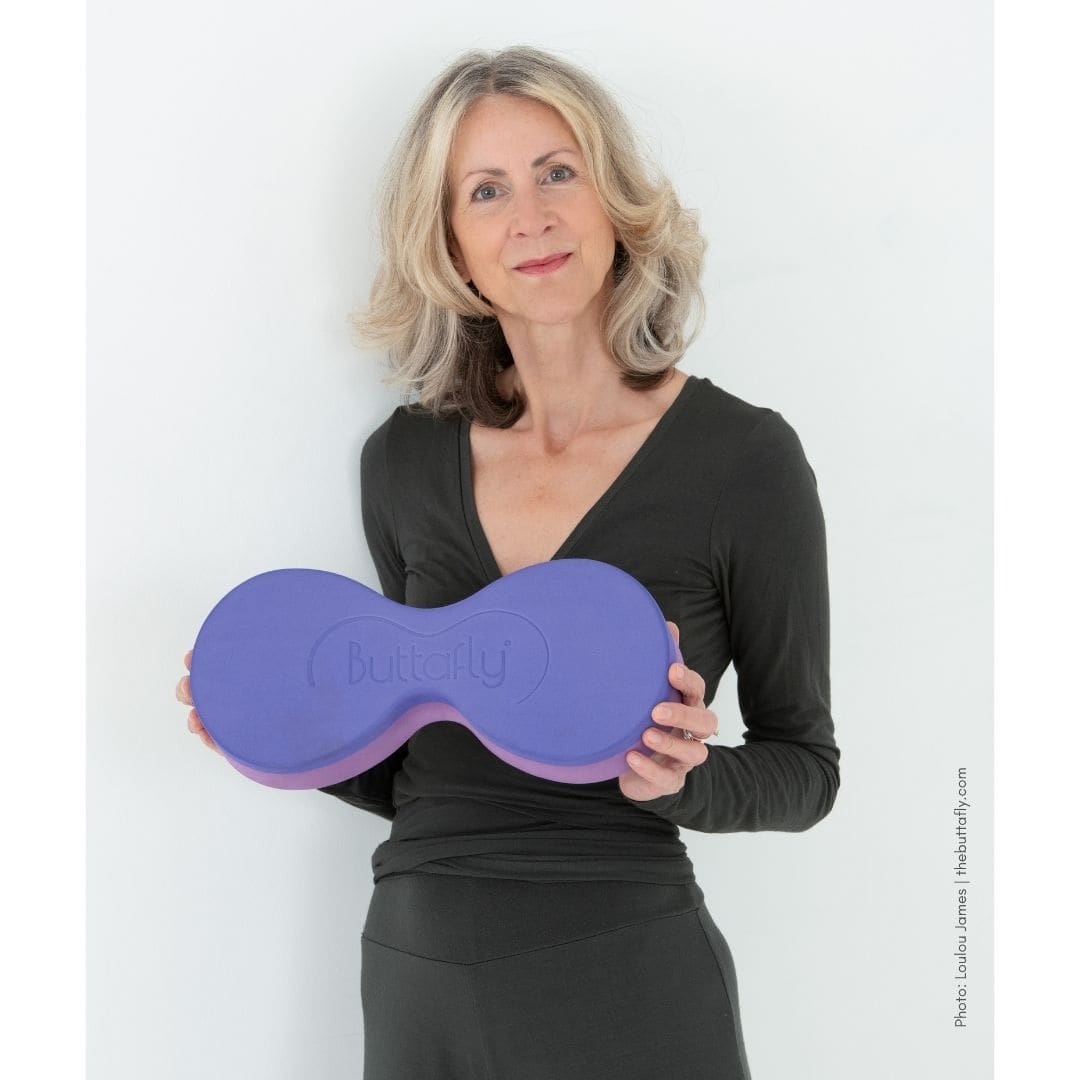
I’m Loulou James, founder of the Buttafly and the Buttafly Technique.
The Buttafly began as a yoga block and meditation seat. How it led me to the Technique is told on the Our Story page.
What I haven’t said there is what came next. I trained as a physiotherapist in the days when massage and mobilisation were at the heart of the profession, and I first explained what I was seeing in mechanical terms. So I was surprised, and honestly sceptical, to find that lying down on a simple device could make such a difference. It sounded like gimmickry, pandering to the desire for a modern-day quick fix.
But over eleven years and around 2,000 people, I’ve watched a similar kind of release happen in nearly everyone: being able to lie flat without bending the knees up, hips that felt different, a sense of being lighter and taller. It was too consistent to ignore, so I started asking different questions, and I’m still asking them.
Your body is listening to your thoughts
Before anything else, here’s a small experiment. It takes just a few minutes, and all you need is somewhere comfortable to sit.
I’ll invite you to imagine two phone calls, one that stirs disappointment and one that brings joy, and simply notice what happens in your body each time. You can stop whenever you like.
Many people are surprised by how quickly the body responds to something that isn’t even happening.
[Guided audio - coming soon]
This is the idea behind the Technique, not the Technique itself.
What I believe is happening
If you tried the experiment, you’ll likely have felt your body taking part in your emotions, even though nothing was actually happening. Our body doesn’t just carry us around. It responds to everything we think and feel.
Most of us have a good idea that posture is shaped by habit. Think of a favourite old sweater, so well worn that it bags at the elbows and has taken on the shape of the shoulders. Our posture is shaped in much the same way, by habits that are physical, like hours driving or at a desk, and emotional, like a familiar worry or a constant readiness. The body organises itself around them, often by bracing, and at some point our posture begins to define us, to the extent that we assume it has become an integral part of our fabric.
In my experience, this is rarely so.
I’ve come to understand the spine as more than our central axis, the backbone that gives the body its structure. It is also home to the spinal cord, the main pathway of the nervous system, so what affects the spine can influence the nervous system too. That’s why how we carry ourselves matters well beyond the physical, and I believe that keen attention to our posture, or more specifically the alignment of the spine, can be a potent way of optimising well-being from the inside out.
With the right support and a little quiet, the Buttafly Technique has shown that the spine can let go of its bracing, without anyone pushing, pulling or forcing.
Getting started
The Buttafly Technique is simple, but it isn’t a quick trick.
Two things make the difference: knowing where your sacrum is (the triangular bone at the base of your spine, between your hips), so the Buttafly sits in the right place, and giving yourself unhurried time, so your nervous system has the chance to settle.
If you’d like to explore more first, watch this short video.
If you’re ready to experience the Buttafly Technique
You’ll need a Standard Buttafly, a few pillows, and about 10 to 20 minutes, followed by 10 to 15 minutes of quiet rest. The Set-Up Guide takes you through it step by step, and many people begin on their own.
If you’d like personalised support to help you find the set-up that suits your body and conditions, you may like to book a consultation with me.
Comfort is always the guide. If you’re pregnant, under active medical care, or have a known serious condition, please read the guidance in the Set-Up Guide before you begin.
How often will I need to do this?
Guided rest
Many people find it easier to settle with a voice to follow. I’ve recorded a guided meditation to accompany the Buttafly Technique.
A single download comes in a 17-minute version and a 35-minute version with extended music for a longer rest.

The Buttafly Technique is probably the best system I’ve used for low back relief, and I’ve tried them all.
— Paul James Donnelly
CEO and co-founder of Winback Medical UK & Ireland
Hear from our customers
I’ve been to physiotherapists, chiropractors, and osteopaths. All have helped in their own way but nothing has resolved the problem. But I’ve recently discovered the Buttafly and it’s been an absolute revelation to me.
— Paul, sedentary occupation, keen cyclist and kick-boxer
The Buttafly has definitely helped me feel more realigned... I always feel straighter afterwards — taller too, and a bit prouder in my posture. I also get sciatic pain, and it’s definitely helped ease that as well.
— Ashton, sports science graduate, accomplished horse-rider
I've been in agony and it's been very tender. I tried the Buttafly this morning and I can't tell you the difference — unbelievable.
— David, retired psychologist and pyschotherapist
I'm blown away by how quickly I felt a difference — nothing else has worked like this.
— Tracey Mellor, yoga and Pilates teacher; founding member of the Fascia Research Society
The body has a deep intelligence and the capacity to bring itself back into balance. We rarely think about how this applies to the spine and posture. I’ve seen that it does, and the Buttafly Technique works with it beautifully.
— Loulou James, MCSP
Founder of the Buttafly and the Buttafly Technique