May 6, 2025
Posture and the nervous system
When most people think about posture, they think about alignment.
They think about how they sit, stand and move. They may have been told to pull their shoulders back, sit up straight or strengthen certain muscles to support better posture.
These things can be useful, but after more than four decades working with the human body, I have come to understand that posture is about far more than the position of our bones and joints.
Posture is a reflection of our relationship with ourselves and the world around us.
It is shaped by our physical habits, our experiences, our emotions, our beliefs, our environment and the way our nervous system responds to life.
Our posture tells a story.
Not a story that can be interpreted simply or reduced to a single cause, but a story of adaptation. A story of how our body has learned to respond to the demands, challenges and experiences we have encountered.
Understanding this changes the way we approach posture.
Rather than seeing the body as something to be corrected, we can begin to see it as something to be understood.
Posture is more than alignment
Posture is not just about how we hold ourselves. It is a reflection of the ongoing conversation between our internal and external worlds.
Two interconnected influences are constantly shaping the way we organise ourselves physically.
External influences: movement, habits and environment
Our physical experiences shape us.
The way we sit, stand and move — repeated day after day, year after year — influences how our body adapts.
Our work, our activities, our injuries, our movement patterns and the environments we spend time in all contribute to the way we organise ourselves physically.
Internal influences: thoughts, emotions and experiences
Our inner world leaves its imprint on the body, too.
Stress, confidence, joy, vulnerability, fear and the many experiences we move through in life can influence the way we breathe, move and carry ourselves.
When we experience prolonged stress or emotional challenge, the body may respond by creating patterns of protection and tension. Muscles may remain more active than necessary. Breathing may change. Movement may become less free and effortless.
Equally, when we experience safety, connection and ease, the body can express itself differently. There may be more freedom, softness and adaptability.
These patterns are not signs that something is wrong with us.
They are intelligent responses from a body that is constantly adapting.
The nervous system: the foundation of adaptation
Over time, these internal and external influences become woven together.
How we feel affects how we carry ourselves.
How we carry ourselves can influence how we feel.
The body and mind are not separate systems. They are in constant communication.
At the heart of this relationship is the nervous system.
The nervous system allows us to respond to our environment. It helps us adapt, protect ourselves and navigate the world around us.
When we experience ongoing stress, the body may remain in a heightened state of alert. This can influence muscle tone, breathing, movement and our ability to relax.
When the nervous system feels safe and supported, the body can move towards a more restorative state.
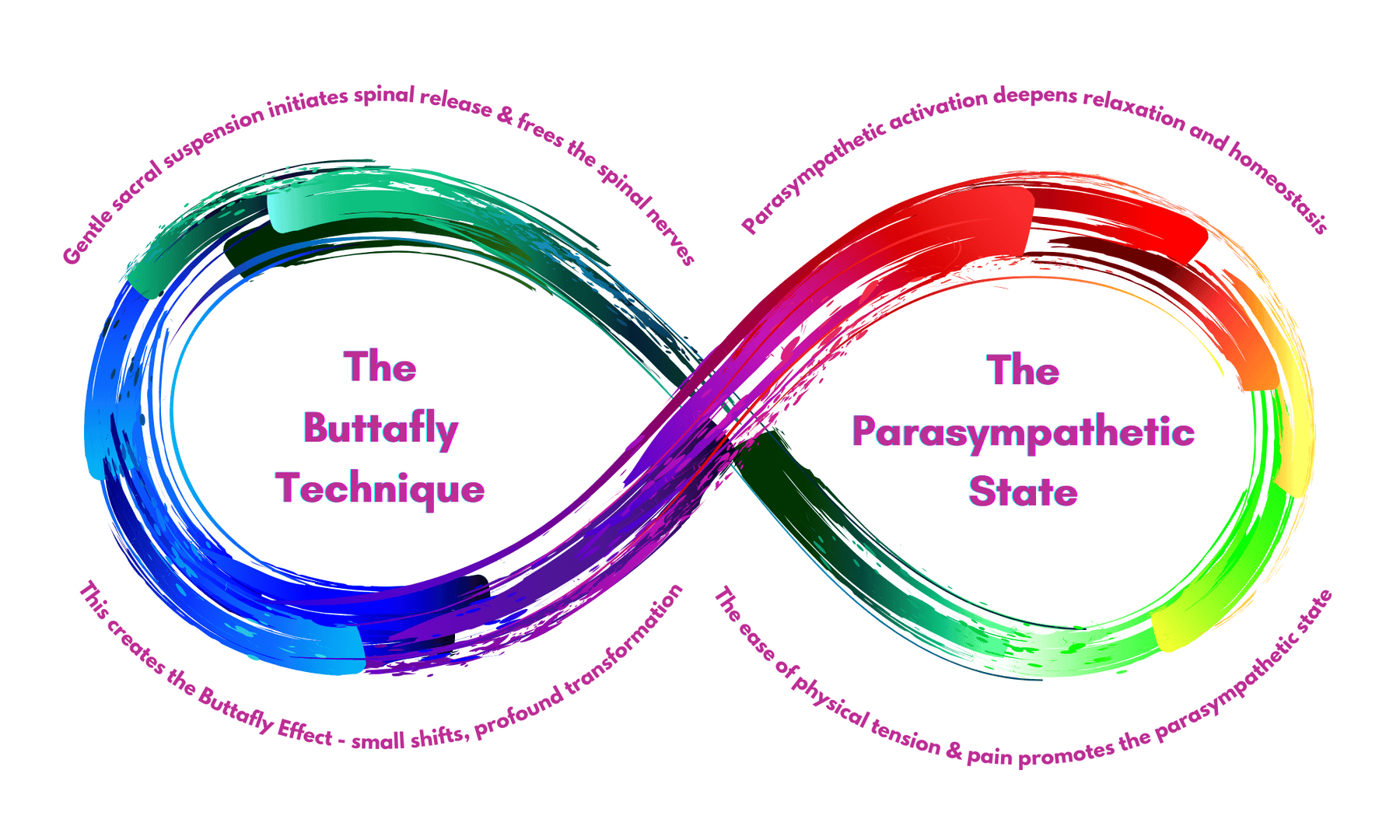
This is where the parasympathetic nervous system becomes so important.
Often described as the body’s “rest and digest” state, the parasympathetic state supports the processes associated with restoration, regulation and balance.
The body is designed to continually seek homeostasis — a dynamic state of balance where all systems work together to support health and adaptation.
Healing is not something we force upon the body.
It is something the body is continually working towards when the right conditions are present.
Why relaxation matters for posture and health
Many people try to change their posture by applying more effort.
They hold themselves differently. They strengthen. They correct.
Yet lasting change requires something deeper.
A body that is constantly holding tension may not need more instruction. It may need an opportunity to release.
When the nervous system settles, the body can begin to let go of unnecessary protective patterns.
Breathing can become easier.
Movement can become more natural.
The body can begin to rediscover balance.
This is why relaxation is not simply about feeling calm. It is a physiological state in which the body can regulate, adapt and restore.
The Buttafly Technique: creating the conditions for change
The Buttafly Technique developed from my observation that when the body is supported in the right way, it has an extraordinary capacity to release unnecessary tension and move towards greater balance.
The gentle suspension of the sacrum allows the spine and pelvis to be supported without force.
Rather than imposing a correction, the technique creates the conditions for the body to respond from within.
As the body relaxes, the nervous system can move towards a more settled state. This allows deeper awareness, greater ease and the possibility of natural change.
The aim is not to create a perfect posture.
There is no single posture that every person should hold.
The aim is to support a body that is adaptable, responsive and able to meet the changing demands of life.
Posture as a pathway to understanding the body
When we begin to view posture in this way, we move beyond the idea that posture is simply something to fix.
Instead, posture becomes a pathway to understanding ourselves.
It invites us to ask:
What has my body been adapting to?
Where am I holding unnecessary tension?
What conditions help me feel more at ease?
These questions open a different conversation with the body.
A conversation based not on judgement, but on curiosity.
The body is not a machine that has failed when it develops tension, pain or imbalance.
It is an intelligent, adaptive system that is constantly responding to life.
When we create the conditions for safety, support and awareness, we give the body the opportunity to return towards balance.
This is the foundation of the Buttafly Technique and one of the reasons I believe posture is about so much more than alignment.

Loulou James | Founder of the Buttafly
Reflections from my work in natural back care and embodied spine health
May your spine be aligned, your body be at ease, and your spirit soar with vitality.