
December 6, 2025
Understanding Bone: The Living Foundation of Our Health
A few days ago, I tripped and fell – a classic FOOSH (Fall On Out-Stretched Hand). Thankfully, nothing was broken, but the experience brought back vivid memories from my years as a physiotherapist, supporting people through post-fracture recovery. It reminded me of the remarkable resilience and healing power of our bones – something we often take for granted until we’re faced with injury or pain.
Bones are so much more than the hard framework beneath our skin. They are living, dynamic tissues, central to our movement, vitality, and lifelong well-being.
Before exploring how our lifestyle, culture, and emotions shape bone health, let’s look at the fascinating biology of bone itself.
Bone basics: structure and function
Bone, together with cartilage – and in partnership with the body’s remarkable fascia – forms the strong and resilient endoskeleton that supports muscle attachment for movement, protects vital organs, and acts as a reservoir for essential minerals like calcium and phosphate. While bone and cartilage provide rigidity and shape, fascia weaves throughout, connecting and supporting every structure, further enhancing our body’s strength, flexibility, and adaptability.
What is bone made of?
- Minerals: About 60% of bone’s weight comes from minerals, mainly hydroxyapatite (calcium and phosphate), giving bone its rigidity.
- Organic matrix: About 25% is organic, mostly type I collagen, which provides flexibility and resilience.
- Water: Makes up the rest, keeping bone tissue hydrated and healthy.
The dynamic nature of bone
Unlike concrete, bone is constantly being renewed. Through a process called bone remodelling, old bone is broken down and replaced with new bone, allowing your skeleton to adapt to life’s changing demands. This is why bones can heal, grow stronger with exercise, and respond to injuries or changes in activity.
Meet the bone cells
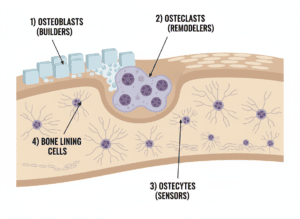
- Osteoblasts: The builders. These cells create new bone by producing collagen and facilitating the deposition of minerals into the matrix.
- Osteoclasts: The remodelers. Large, specialised cells that break down old bone, releasing minerals back into the bloodstream.
- Osteocytes: The sensors. Former osteoblasts that become embedded in bone, they sense mechanical stress and communicate with other cells to direct bone remodelling.
- Bone lining cells: Protect bone surfaces and can reactivate to become osteoblasts when needed.
How bone cells communicate and regulate each other
Bone health depends on a delicate balance between formation (osteoblasts) and resorption (osteoclasts). These cells communicate using chemical signals to regulate when to build or break down bone.
Genes, proteins, epigenetics, and bone health
Bone remodelling in everyday life
Bones remodel throughout life, repairing micro-damage, supporting new activities, and maintaining mineral balance. This process is most active during growth, but continues as we age. With menopause or inactivity, bone resorption can outpace formation, leading to conditions such as osteopenia and osteoporosis.
Conclusion: The foundation for holistic bone health


Loulou James | Founder of the Buttafly
Reflections from my work in natural back care and embodied spine health
May your spine be aligned, your body be at ease, and your spirit soar with vitality.