
The Buttafly Technique during pregnancy: gentle, practical spine support
The Buttafly Technique can be used during pregnancy, and many women find it a gentle, effective way to ease lower back and pelvic tension.
It’s a non-invasive self-care practice designed to support your body’s innate intelligence — helping you tune into comfort, alignment, and your own inner feedback, rather than forcing change.
Why it can feel so supportive in pregnancy
The most active movement in the Technique is simply coming into a small bridge position to place the Buttafly under your pelvis. Once you’re settled, with the right support under your knees, your pelvis and lower back should feel neutral and comfortable.
The classic Buttafly Technique creates a very slight inversion. If you prefer to reduce that feeling during pregnancy, you can easily adjust by placing a folded blanket — or another Standard Buttafly — under your upper back.
Many women find the precise positioning of the Buttafly, combined with comfort and stillness, helps the pelvis and spine settle into a more natural organisation — often bringing a sense of ease through the whole body and supporting deep relaxation.

The Buttafly Technique is designed to be gentle and low-demand during pregnancy. Prioritise comfort, listen to your body, and adjust your support as needed.
Comfort and positioning matter — especially as pregnancy progresses
- If you feel comfortable, supported, and at ease, you’re likely on the right track
- If something feels off, uncomfortable, or painful, pause and adjust
- If you’re unsure how to adapt the setup for your body, get guidance so you can practise with confidence
Trimesters: a grounded, self-responsible approach
First trimester
Second and third trimesters

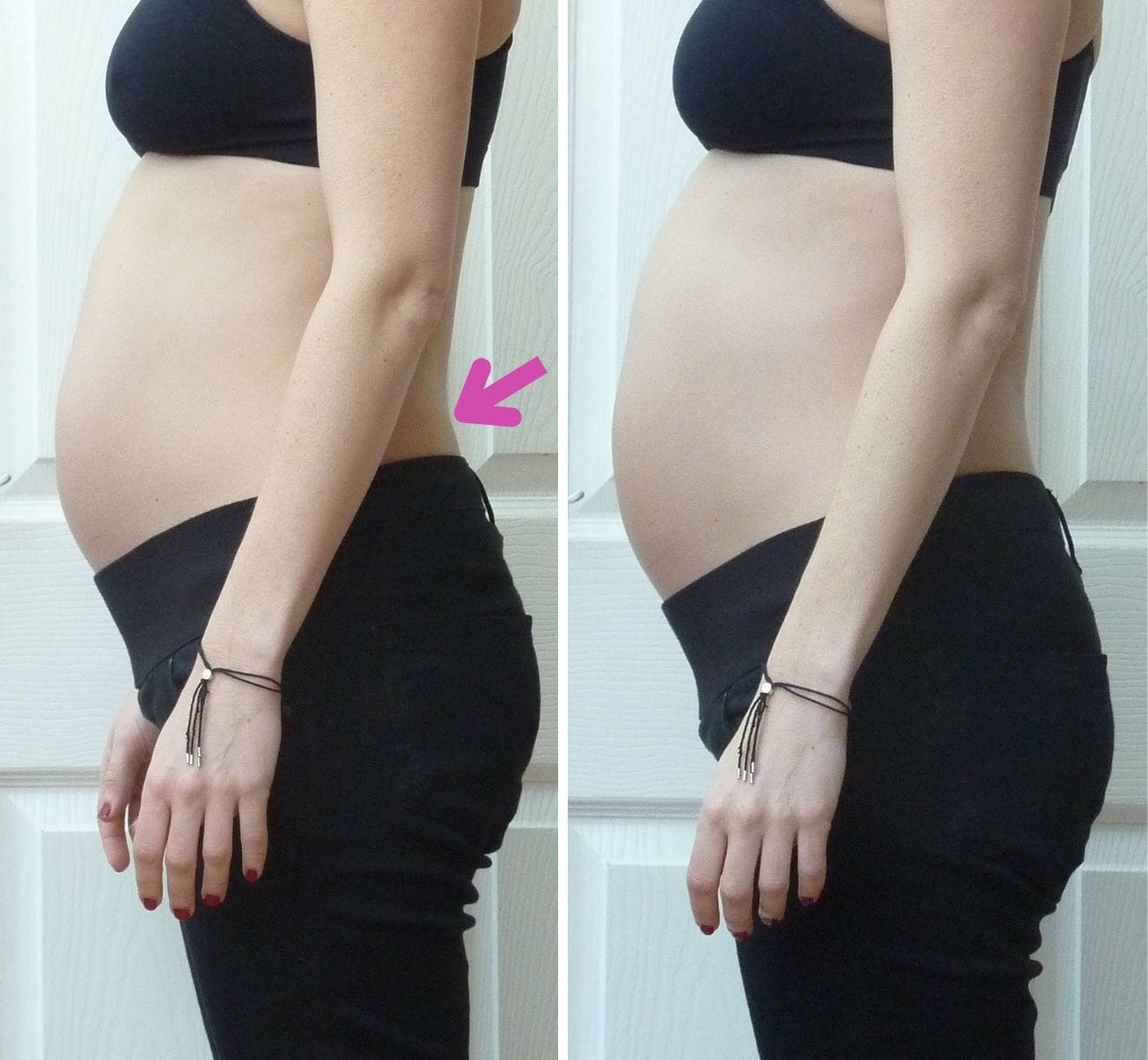
Case study during second trimester
This before-and-after image shows a pregnant woman’s posture during the second trimester and her baby’s position, demonstrating the effects of the Buttafly Technique.
In the first photo on the left, we can see that while her posture is fairly well-aligned overall, there is a distinct over-arch or "hinge" in her lower back (pink arrow).
In the second photo, after a 20-minute session with the Buttafly Technique, her spine and pelvis are more naturally aligned, and the baby's position has changed, easing pressure on the pelvic girdle.
Common pregnancy-related discomforts
Below are some common pregnancy-related discomforts many women experience; the Buttafly Technique may offer gentle support by prioritising comfort, precise positioning, and your body’s feedback.
- Low back pain
- Rib pain
- Pelvic girdle pain
- Pubic symphysis pain
- Hip pain
- Sciatica
- Upper back pain
- Indigestion

Learn the Buttafly Technique: setup and support
To learn the setup step by step, visit: https://thebuttafly.com/how-to-set-up-the-buttafly-technique/
If you’d like support adapting the Technique for your pregnancy — and reassurance that your positioning is precise — book a 1:1 online consultation with Loulou James, creator of the Buttafly and Spine Health Specialist.

The body has a deep intelligence and the capacity to bring itself back into balance. That said, we rarely, if at all, consider how this applies to the spine and posture. But it does, and the Buttafly Technique harnesses it beautifully.
— Loulou James, MCSP
Spine Health Specialist and the designer of the Buttafly